


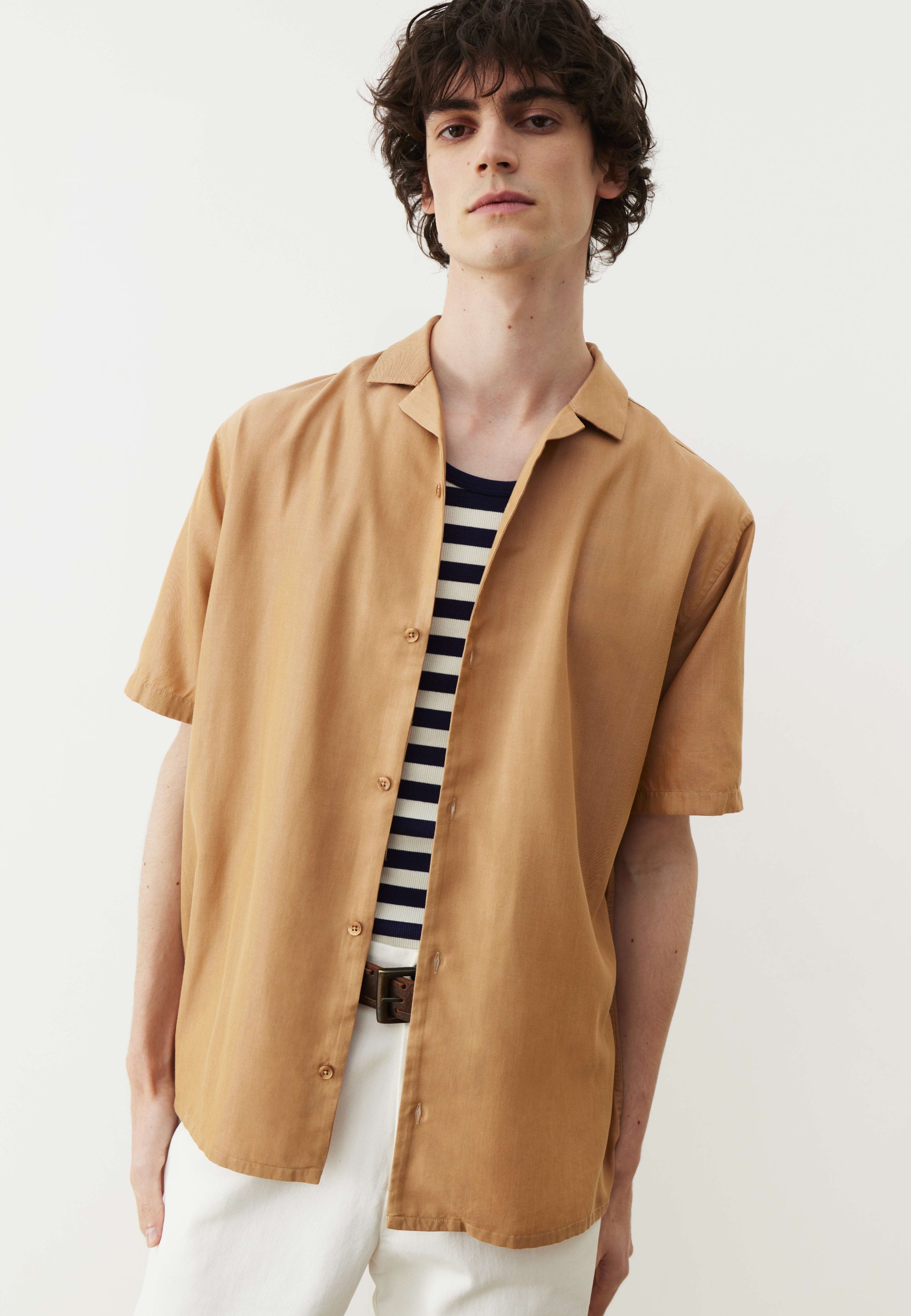
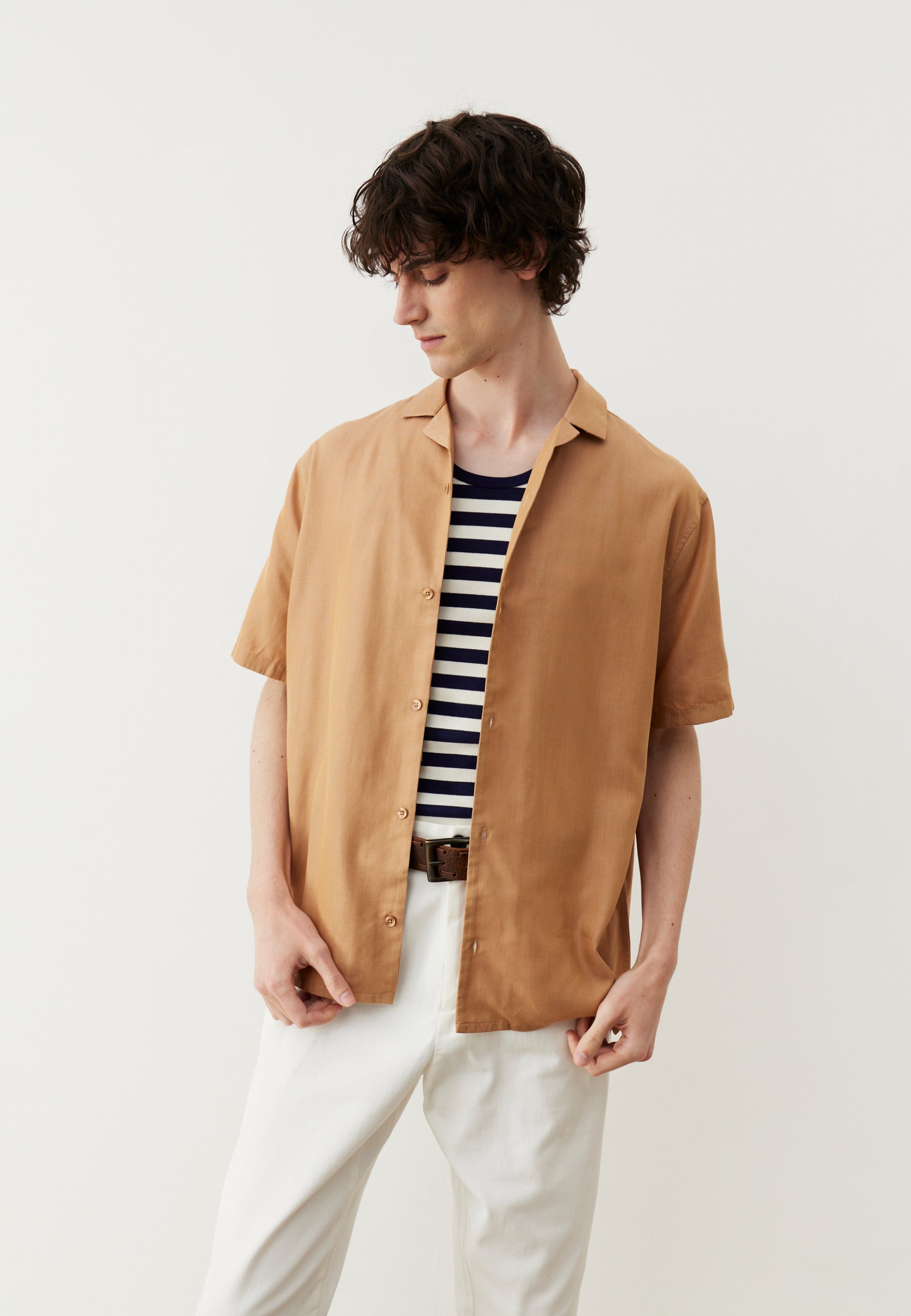
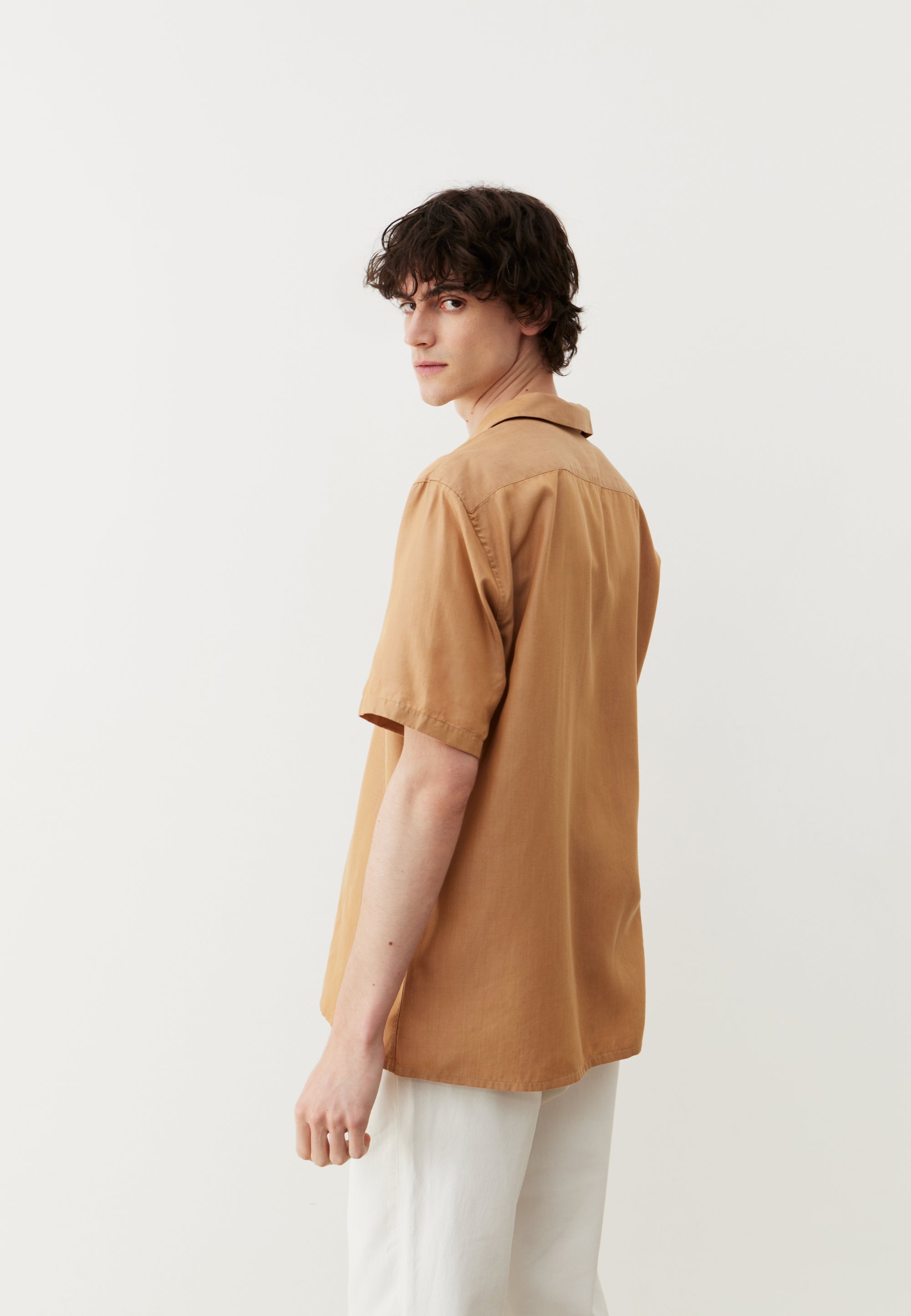
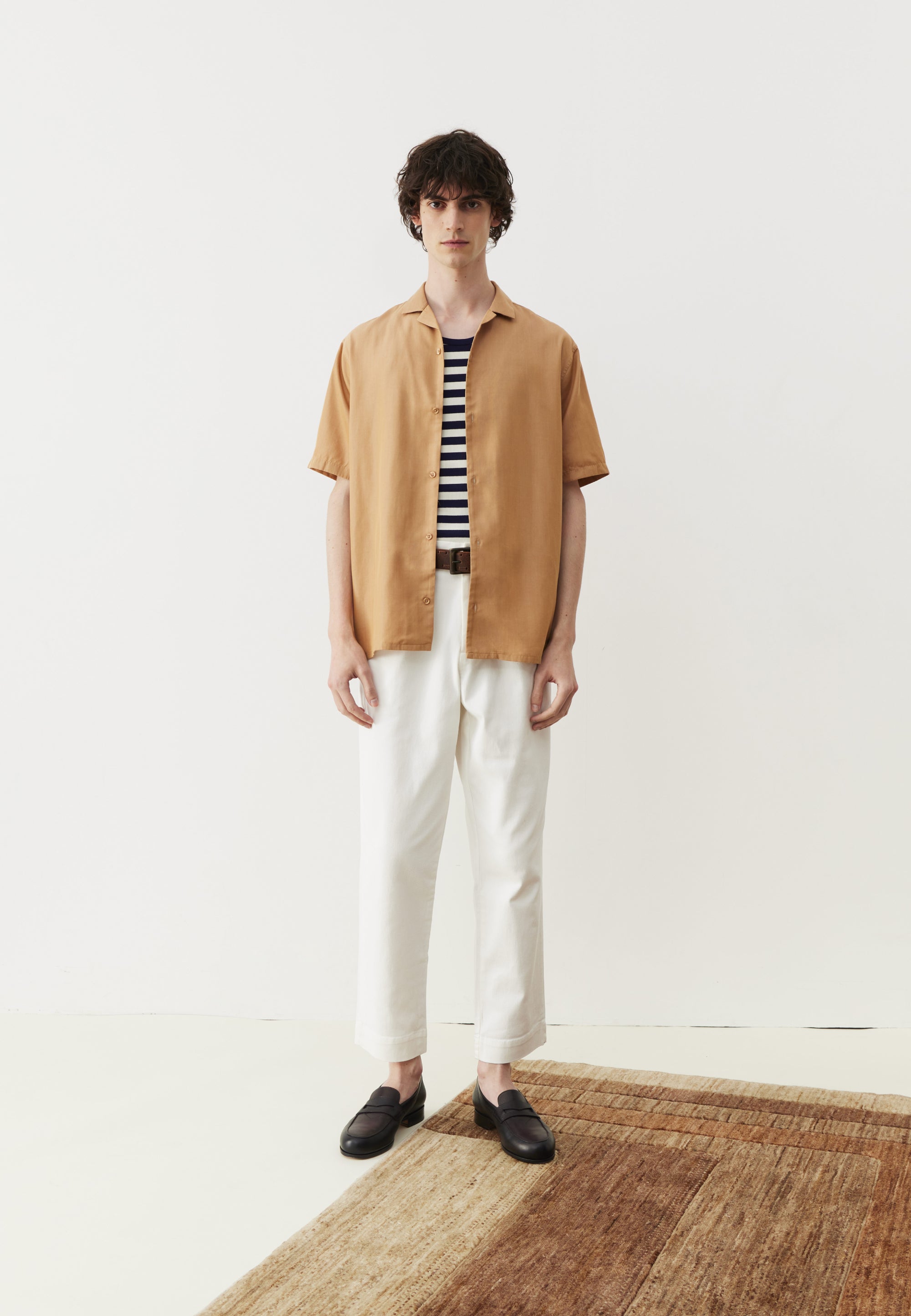


The Tencel short-sleeve shirt
Coming in May 2023
Tencel is a bit like viscose: a synthetic material made from wood pulp. Except that the chemical processes used are less polluting, and it’s manufactured in Austria.
This means there is enough room to allow air to circulate, preventing you from sweating or feeling constricted.
Techniques That Ensure Quality
 Ringpsun Yarn
Also known as “ring spinning,” this technique produces a fine, soft, and strong yarn.
 Ringpsun Yarn
 Tencel fabric
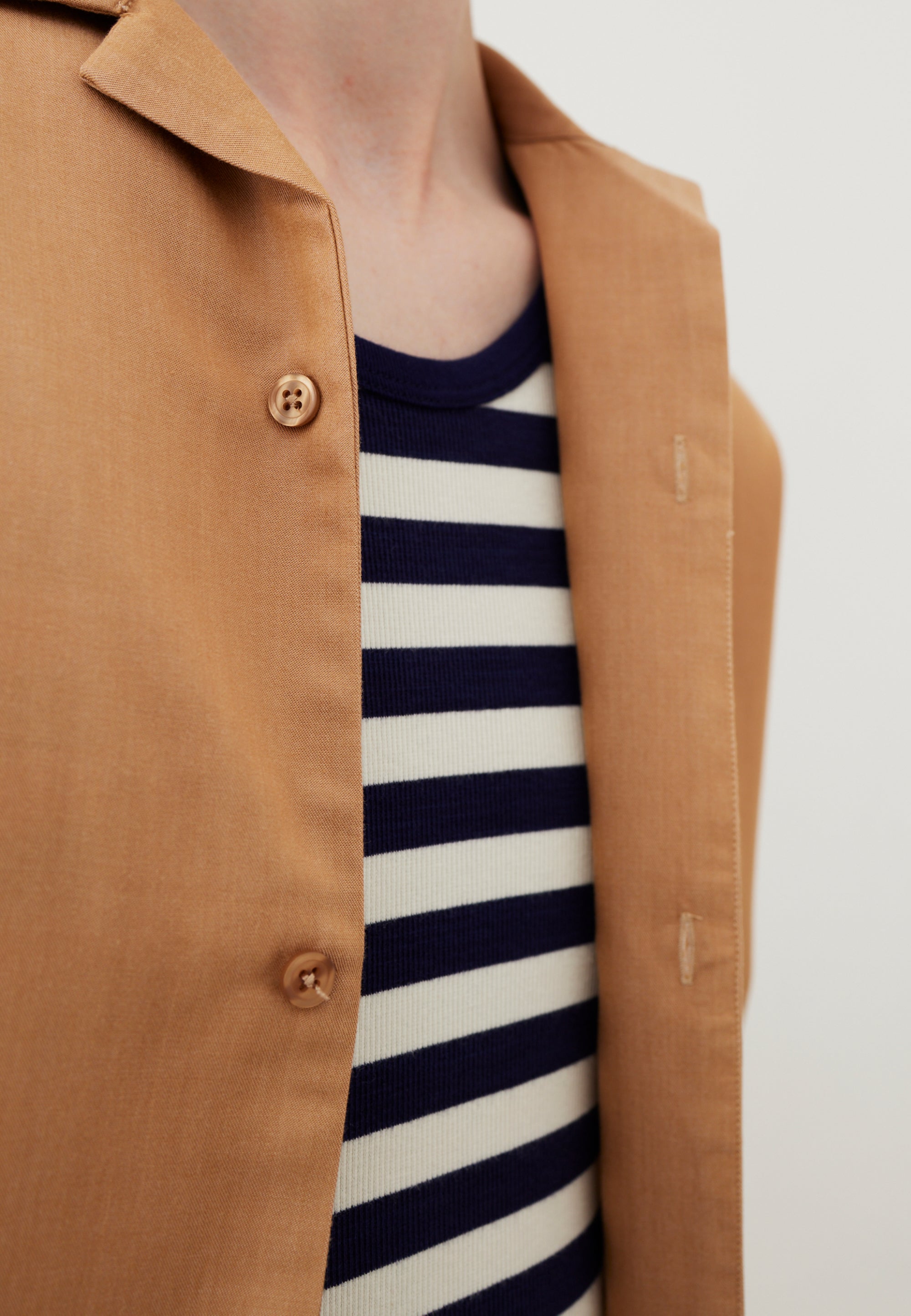
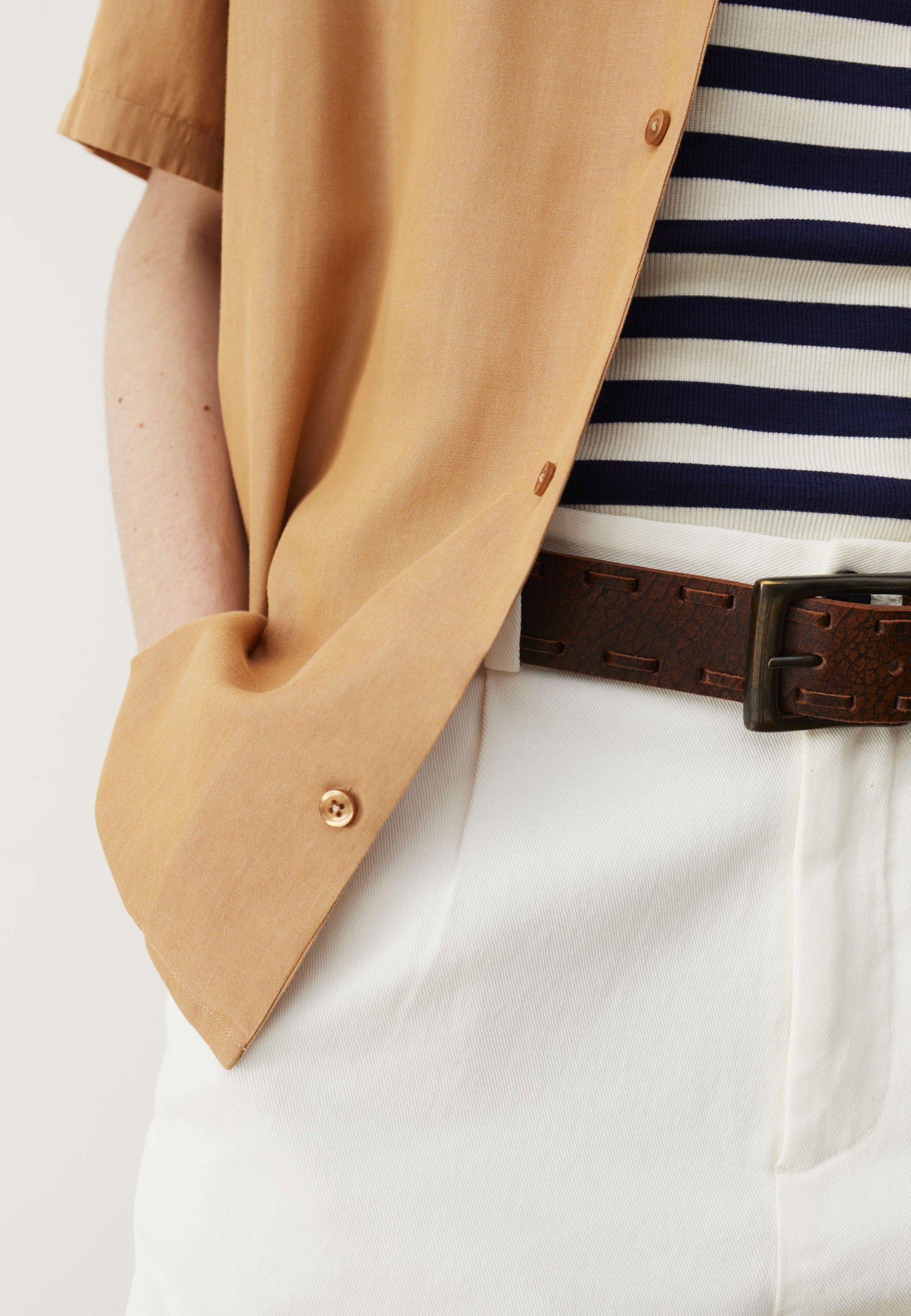
 Thick buttons
 Ascolite® Fastener
 Tencel fabric
To keep you cool, we’ve replaced the usual cotton with Tencel. First, because this fabric is much more breathable (it absorbs and wicks away sweat). Second, because it’s soft, cool, and doesn’t stick to the skin.
Ringpsun Yarn
Tissu Tencel
Thick buttons
Ascolite® Fastener
 Thick buttons
We chose thick resin buttons that won’t break in the washing machine, unlike those made of wood or mother-of-pearl.
Just in case, a spare button is sewn onto the care label.
Ringpsun Yarn
Tencel fabric
Thick buttons
Ascolite® Fastener
 Ascolite® Fastener
To ensure that the buttons don't come undone, we've reinforced their attachment using Ascolite technology, a process that involves wrapping the base of the button with a heat-sealed thread.
Ringpsun Yarn
Tencel fabric
Thick buttons
Ascolite® Fastener
100% Tencel
A shirt that’ll keep you cool: we’ve chosen a straight cut that’s not too form-fitting and a soft, sweat-wicking fabric—Tencel, a fiber made from wood pulp. And we’ve designed it to look impeccable even when it gets (increasingly) hot: discreet buttons, an invisible button placket, and fabric that resists wrinkles.
Composition
100% Tencel
Origin and Certifications
Weaving, manufacturing: Portugal
; Spinning: Portugal (weft), India (warp)
; Tencel: Austria
...manufacture in Portugal instead of France? Of course, manufacturing in Portugal allows us to sell at lower prices. But it’s also easier to produce high-quality goods there: in the 1980s, when France outsourced its manufacturing, Portugal strengthened its own. Still, other companies besides ours manage to make shirts that are 100% made in France, like 1083.
How This Product Will Age
How do we know this? We ask our customers for their feedback on the product one year after purchase. And if the product is less than a year old, we provide our predictions based on some unsolicited feedback and our experience with similar products.
The color will fade slightly with each wash, but it will still look great (we chose it so that it would develop a nice patina).
Since it’s Tencel, tiny fibrils will appear on the fabric over time, but they have two advantages: they make the fabric less shiny and softer as it ages.
Care Instructions
Good to know: Over time (and with machine washing), the sheen fades.
There’s no need to wash this shirt too often: you’ll find that, in most cases, airing it out for 24 hours is enough to get rid of odors.
But when it’s time to do laundry, unbutton it completely, turn it inside out (to minimize pilling), and wash it at 30°C (to prevent shrinkage). No need for a dryer: hung on a hanger, it will dry in no time.
Environmental Cost
This environmental cost is calculated using the official methodology of the French environmental labeling system (to be rolled out starting October 1, 2025).

The label above shows the product’s environmental cost according to the official French environmental labeling methodology. This represents what its production “costs” nature when considering its impact on climate change, ocean acidification, its toxicity to freshwater, and so on. Currently in use in the textile sector, this label should soon appear on many everyday consumer products (food, cosmetics, furniture, etc.) to help you make more eco-friendly purchasing decisions.
The short-sleeved Tencel shirt therefore has an environmental cost of 526 impact points*.
By comparison, a garment of equivalent weight, made of 100% viscose, manufactured in Bangladesh, and sold by a fast-fashion brand, has an environmental cost of 1,461 points*.
Why is there this difference? Here are the main reasons:
- Countries of origin: Manufacturing in Portugal or France requires less fossil fuel energy than in Bangladesh (one of the leading producers of low-cost clothing). As a result, this more local manufacturing reduces the impacts on climate change, ocean acidification, and resource depletion.
- The fabric: Tencel is more environmentally friendly than viscose, which is typically used by fast fashion brands for this type of drape. Both fabrics are made from wood pulp, but Tencel is manufactured using non-toxic solvents in nearly closed-loop facilities.
- Sustainability: Fast-fashion retailers encourage purchasing—in particular by rapidly refreshing their collections and offering a vast number of styles—and they discourage repairs by charging rock-bottom prices. This, in turn, increases the number of garments sold per person and reduces the number of times a garment is worn. In contrast, at Loom, we’ve chosen to adopt business practices that encourage our customers to keep their clothes for as long as possible.
Even though we've done everything we can to minimize it, this product's environmental impact is not insignificant. So before you buy, make sure to get the most use out of your clothes.
*Calculations performed by Loom on August 24, 2026. Click on the links to access the simulations from the official Ecobalyse tool and get more details on the assumptions used. Please note: The number of points is not always exactly the same on Ecobalyse (whose methodology changes regularly) as on the official environmental label (based on Ecobalyse version 7.0).
Reviews of this product
The standard practice is to send review request emails a few days after the purchase. We wait a month—the minimum amount of time needed to form an informed opinion.
Customer Review Policy
When do you ask customers for reviews?
We’ll send you a review request one month after we receive your order. We believe this is the minimum amount of time needed to have worn and washed an item several times and to form a truly informed opinion. After that, all your reviews are published within a week, whether they’re positive or negative.
Do you request reviews for 100% of the products ordered by customers?
We used to do that at first, but then we realized we were starting to send way too many emails to certain customers who shop with us regularly. In short, we were spamming them a bit. Plus, it was starting to take the team way too much time to respond to reviews—since we want to reply individually and privately to almost everyone who leaves us a review. Today, we no longer ask for reviews on products that meet the following two criteria: 1/ There are enough reviews posted on the site for potential buyers to form an informed opinion about the product. 2/ We on the Loom team have read enough reviews to understand how to evolve the product into the next generation.
Just a quick thought: What proof is there that we aren't manipulating reviews by giving 5-star ratings to everything?
Honestly: nothing—we’re just giving you our word. Just like with everything else, actually: where we manufacture our products, where our wool comes from, our lab test results, and so on. The only times we might edit what you write is if your message contains spelling mistakes (and even then, quite a few slip past us) or if it’s racist, homophobic, etc. (but that’s never happened so far).
Asking for feedback after just one month isn't enough to know if the clothes are really durable, is it?
You're right—that's why we send you another email asking for a review one year after your purchase—we even ask for a photo to see how your garment has aged. We use the responses to improve our clothing and to provide information on “how this product will age” on our product pages. To avoid unnecessarily bothering our customers, we don’t ask for reviews on 100% of the products ordered: as soon as we have enough data to understand where we can improve, we stop asking for reviews after one year.