


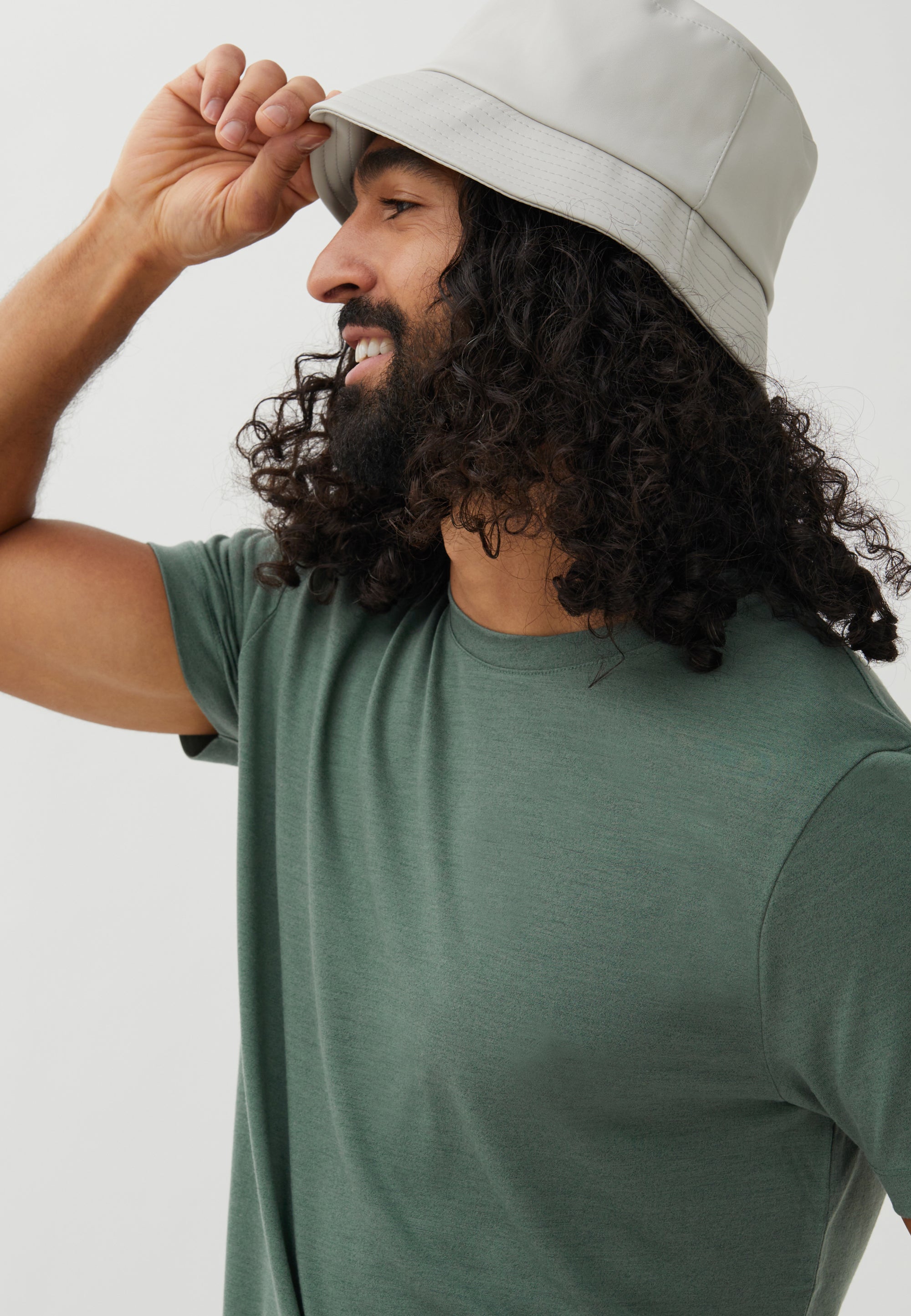
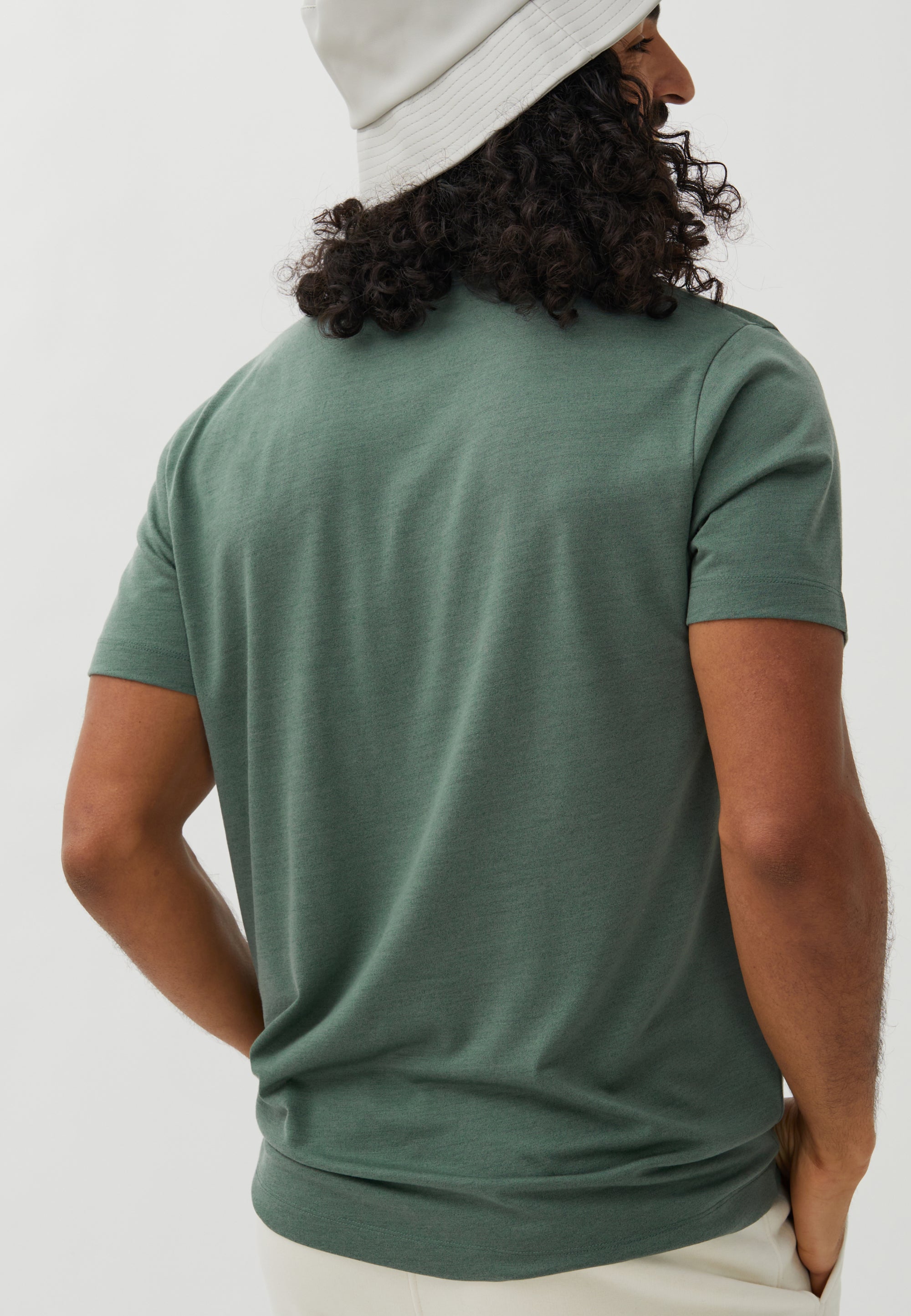
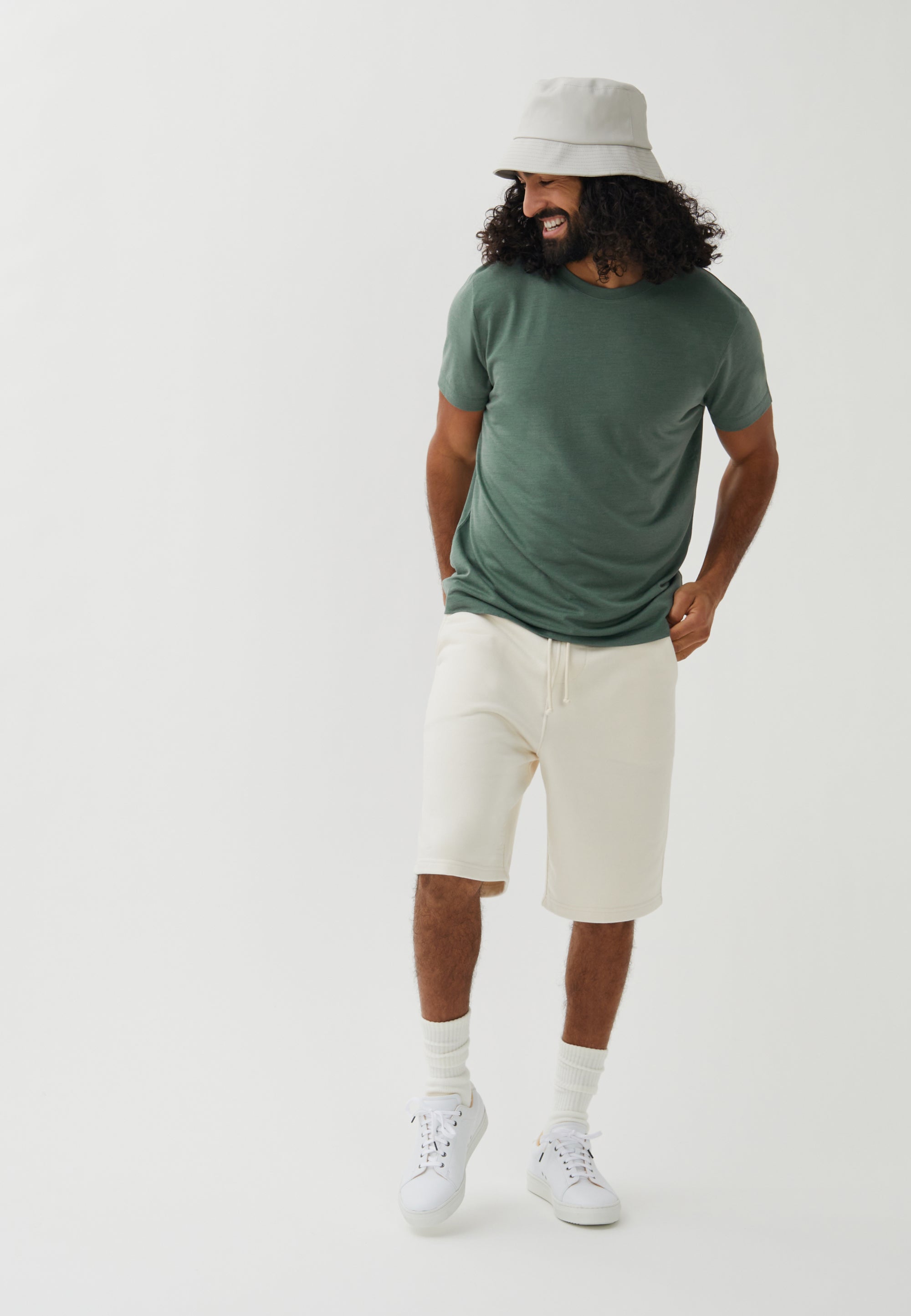


The merino T-shirt
We know a t-shirt at €75 isn't exactly cheap. But this merino wool fabric is very expensive and we manufacture in Europe: we've trimmed our margin on this product as far as it can go. This is the lowest price you'll find for this quality and these production ethics.
05/2022
This t-shirt is made mostly of wool, which is why it doesn't wrinkle, doesn't lose its shape and barely holds onto odours. It also contains a bit of polyamide to make it more durable.
The merino wool in this t-shirt is exceptionally fine (17.5 microns in diameter, when most merino wools hover around 20 microns). The finer the wool fibres, the less stiff they are and the less they prickle.
3 times more durable than a 100% wool t-shirt thanks to an added nylon thread.
Our merino-polyamide wool yarn has been treated so it can go in the washing machine without felting.
This t-shirt is made in Portugal, at the Triwool factory we've been working with since 2017.
Worn, tested and approved by thousands of customers, this t-shirt is the result of a quality-ethics-price trade-off that we now consider spot-on. For instance, we could lower the amount of nylon in its makeup, but that would make it far less durable.
The techniques that ensure quality
 Wool - polyamide blend
We use a wrap-spun yarn: the polyamide (tougher) wraps around the wool (more fragile) to protect it. Compared with a top-quality 100% merino model, our t-shirt pills less (a score of 4 vs. 3 — see the lab test results here) and holes take three times as long to appear (45,000 cycles vs. 14,000 — see the test results here).
 Wool - polyamide blend
 Pre-washing
 Pre-washing
This t-shirt is stabilized and pre-washed at the factory, so it won't shrink on you at home.
Wool - polyamide blend
Pre-washing
The t-shirt for busy days


Knitted from a very fine, machine-washable wool, this t-shirt barely holds onto odors, doesn't itch, doesn't wrinkle and won't lose its shape. It's also 3 times more durable than a 100% wool one, because we protected the fiber by wrapping it in nylon. A t-shirt made for travel and stressful days.
In detail

Fluid fabric
Even though this t-shirt has a fairly high density for wool (170g/m2), it isn't stiff in the slightest and drapes naturally over your body.

Clean finish trim
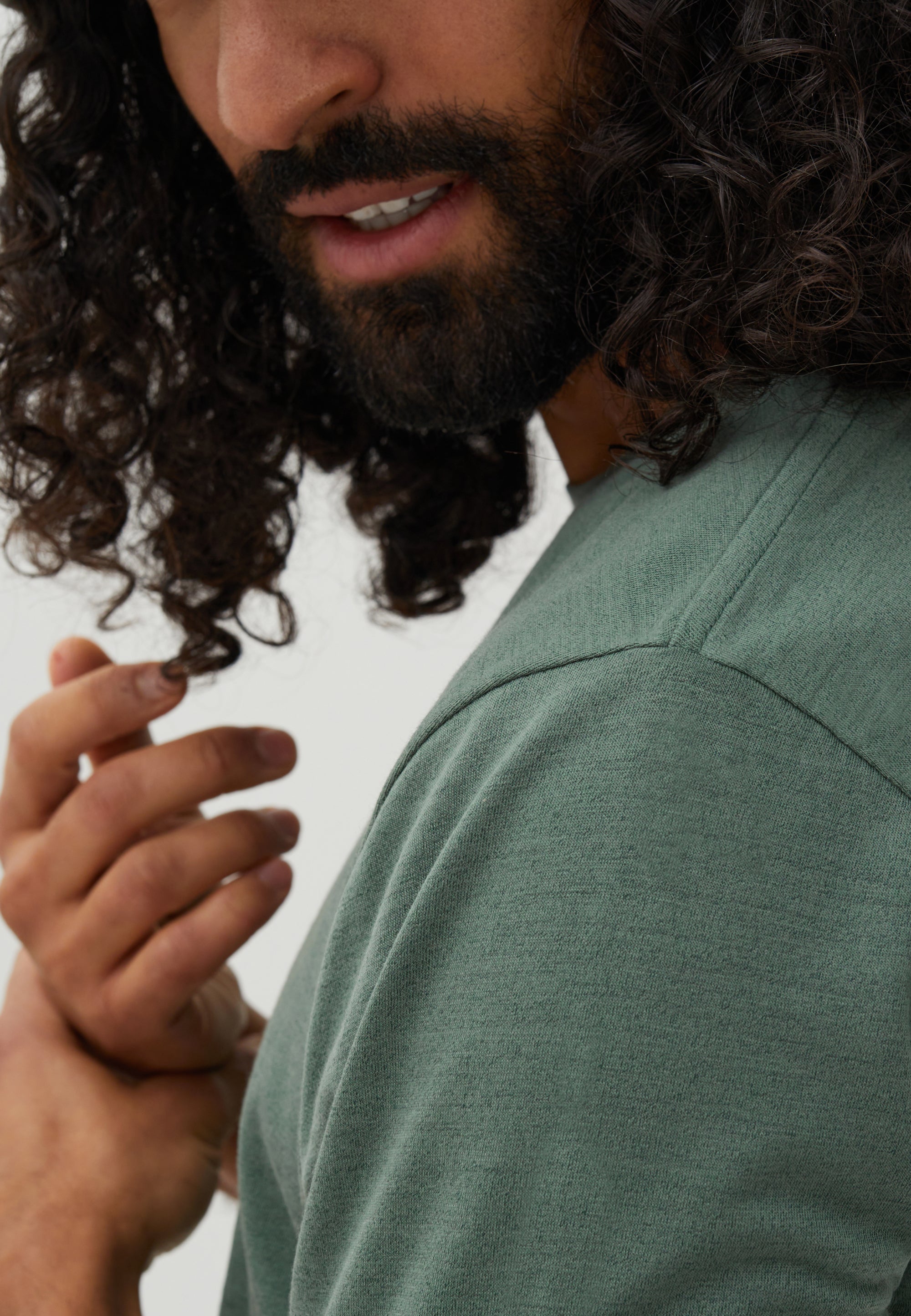
The finishing tape runs all the way across the shoulder line: it lasts longer over time, and it helps the t-shirt sit nicely.

Printed logo
To avoid scratchy labels at the neck and attachment seams that damage the fabric.
How to wear it
A few ideas if you're stuck


Composition
80% wool, 20% polyamide.
Origin and certifications
- Making, knitting, dyeing: Portugal
- Spinning: China
- Wool: South Africa
... make it in Portugal and not in France? Of course, producing in Portugal lets us sell it for less. But it's also easier to make good quality there: back in the 80s, when France was offshoring its industry, Portugal was building its own up. That said, others do manage to make merino t-shirts that are 100% made in France, like Ogarun.
... does the yarn come from so far away? To make this t-shirt, we use a very special yarn: very fine merino wool wrapped in polyamide and treated so it can go in the washing machine. We'd have preferred a spinning mill closer to home, but we haven't (yet) found this quality anywhere else.
... does the wool come from so far away? Extra-fine merino wool always comes from far away: mainly from China, Australia, New Zealand, South Africa and Argentina. We buy the yarn directly, so we can't choose where the wool comes from.

How this product will age
How do we know? We ask our customers what they think of the product one year after they've bought it. And if the product is less than a year old, we give you our predictions based on some spontaneous feedback and on our experience with similar products.
The t-shirt will stay in great shape. Thanks to the merino wool, no one has reported any stretching. And thanks to the polyamide, so far no one has ever reported a single hole or pill.
The collar may curl a bit in places: it's something we've seen with every other merino t-shirt on the market, and we don't think we can improve on this point. A quick pass with the iron puts it right back.
The color will lose some depth with washing. The good news is that, since it fades evenly, it doesn't look worn out, just a little less intense. To slow this down, be sure to wash this t-shirt inside out.
Lastly, we've had a few cases of slight discoloration around the armpits with this t-shirt: some acidic sweat "attacks" the dye on the wool. This discoloration can happen on any color, but it seems to occur mostly on the orange one.
Care instructions
The first time you wear it, you might feel the t-shirt prickle or itch a little. Don't worry, your skin will get used to it very quickly and that feeling will soon fade.
Wool is fungicidal and bactericidal: it holds on to odours very little. So no need to wash this t-shirt too often. Airing it out is usually enough.
It's machine washable at 30°C: the wool has been treated to reduce felting and stop the t-shirt from dropping three sizes. But BE CAREFUL, if you went for the pale yellow, be sure to wash your t-shirt with other light-coloured clothes unless you want it to change colour (wool soaks up so-called "fugitive" dyes far more than cotton does).
No tumble dryer, to avoid shrinking it, but don't dry it on a hanger either: your damp t-shirt is heavy and could lose its shape under the weight of the water. A drying rack is the way to go.
Little bobbles appearing where the fabric rubs? It happens. In this article we explain how to de-bobble your clothes effectively.
And if your t-shirt loses its shape, we explain here how to fix this easily using nothing but your iron.
Environmental cost
This environmental cost is calculated using the official methodology of the French environmental labelling scheme (in force since 1 October 2025).

The label above shows the product's environmental cost according to the official methodology of the French environmental labelling scheme. It's what its manufacture "costs" nature when you look at its impact on climate change, ocean acidification, its toxicity to freshwater, and so on. Currently rolled out in the textile sector, this label should soon appear on many everyday consumer products (food, cosmetics, furniture, and more) to help you shop in a more eco-responsible way.
The merino t-shirt therefore has an environmental cost of 856 impact points*.
By comparison, a garment of equivalent weight, 100% polyester, made in Bangladesh and sold by a fast fashion brand, has an environmental cost of 1201 points*.
Why the difference? Here are the main reasons:
- The countries of production: making clothes in Portugal or France uses less fossil fuel than in Bangladesh (one of the main producers of low-cost clothing). The result: this more local production limits the impacts on climate change, ocean acidification and resource depletion.
- The material: wool has a fairly significant environmental impact, largely because sheep release methane as they digest, a gas with a strong greenhouse effect. That's why the gap between our product's impact and fast fashion's isn't very big. That said, unlike polyester, wool has real advantages: it's warm (thanks to its insulating properties), keeps its shape (the fibre is very elastic), breathable (it wicks away sweat) and odour-resistant (it stops bacteria from developing).
- Durability: fast fashion brands push you to buy by refreshing their collections at breakneck speed and offering a huge number of styles, and they discourage repairs by charging laughably low prices. This drives up the number of garments sold per person and cuts down the number of times a garment gets worn. At Loom, we've taken the opposite route: our business practices are built to encourage our customers to keep their clothes as long as possible.
Even though we've done everything to keep it as low as possible, this product's environmental impact isn't negligible. So before you buy, make your clothes last as long as you can.
*Calculations made by Loom on 31/08/2026. Click the links to open the simulations in the official Ecobalyse tool and get more detail on the assumptions used. Note: the number of points isn't always exactly the same on Ecobalyse (whose method is updated regularly) as on the official environmental label (based on version 7.0 of Ecobalyse)
Reviews for this product
The standard practice is to send review request e-mails a few days after the purchase. We wait a month, the minimum time needed to form a well-informed opinion
Politique d'avis client
Quand demandez-vous des avis aux clients ?
On vous envoie une demande d’avis un mois après la réception de votre commande. On estime que c’est le minimum de temps nécessaire pour avoir porté et lavé un vêtement plusieurs fois et se faire vraiment un avis éclairé. Ensuite, tous vos avis sont publiés dans la semaine, qu’ils soient bons ou non.
Est-ce que vous demandez des avis sur 100% des produits commandés par les clients ?
On le faisait au début, puis on s’est rendus compte qu’on commençait à envoyer beaucoup trop d’emails à certaines personnes qui achètent régulièrement chez nous. Bref, on spammait un peu. En plus, ça commençait à nous prendre vraiment beaucoup trop de temps dans l’équipe de répondre aux avis - puisqu'on veut répondre individuellement en privé à presque chaque personne qui nous laisse un avis. Aujourd’hui, on ne demande plus d’avis sur les produits qui répondent aux deux critères suivants : 1/ Il y a suffisamment d’avis affichés sur le site pour que les personnes qui souhaitent acheter puissent se faire une opinion éclairée sur le produit 2/ Nous avons lu dans l’équipe Loom suffisamment d’avis pour comprendre comment faire évoluer le produit à la prochaine génération.
Minute papillon : qu’est-ce qui prouve qu’on ne modifie pas les avis en mettant des 5 étoiles partout ?
Honnêtement : rien, on vous donne juste notre parole. Comme pour le reste d’ailleurs : où on fabrique, d’où vient notre laine, la note de nos tests labos, etc. Les seules fois où on pourrait toucher à ce que vous écrivez, c’est si votre message contient des fautes d’orthographe (et encore y en a pas mal qui nous échappent) ou s’il est à caractère raciste, homophobe, etc (mais ça n’est jamais arrivé pour l’instant).
Demander un avis au bout d’un mois, ce n’est pas assez pour savoir si les vêtements sont vraiment durables, non ?
Vous avez raison, c’est pour ça qu'on vous envoie un autre e-mail de demande d'avis un an après votre achat – on demande même une photo pour voir comment votre vêtement a vieilli. Les réponses nous servent à améliorer nos vêtements et à donner des informations sur "comment ce produit va vieillir" dans nos pages produits. Pour ne pas solliciter inutilement nos clients et nos clientes, on ne demande pas ces avis sur 100% des produits commandés : dès que nous avons suffisamment de données pour comprendre les points d’amélioration, nous arrêtons demander les avis à un an.