


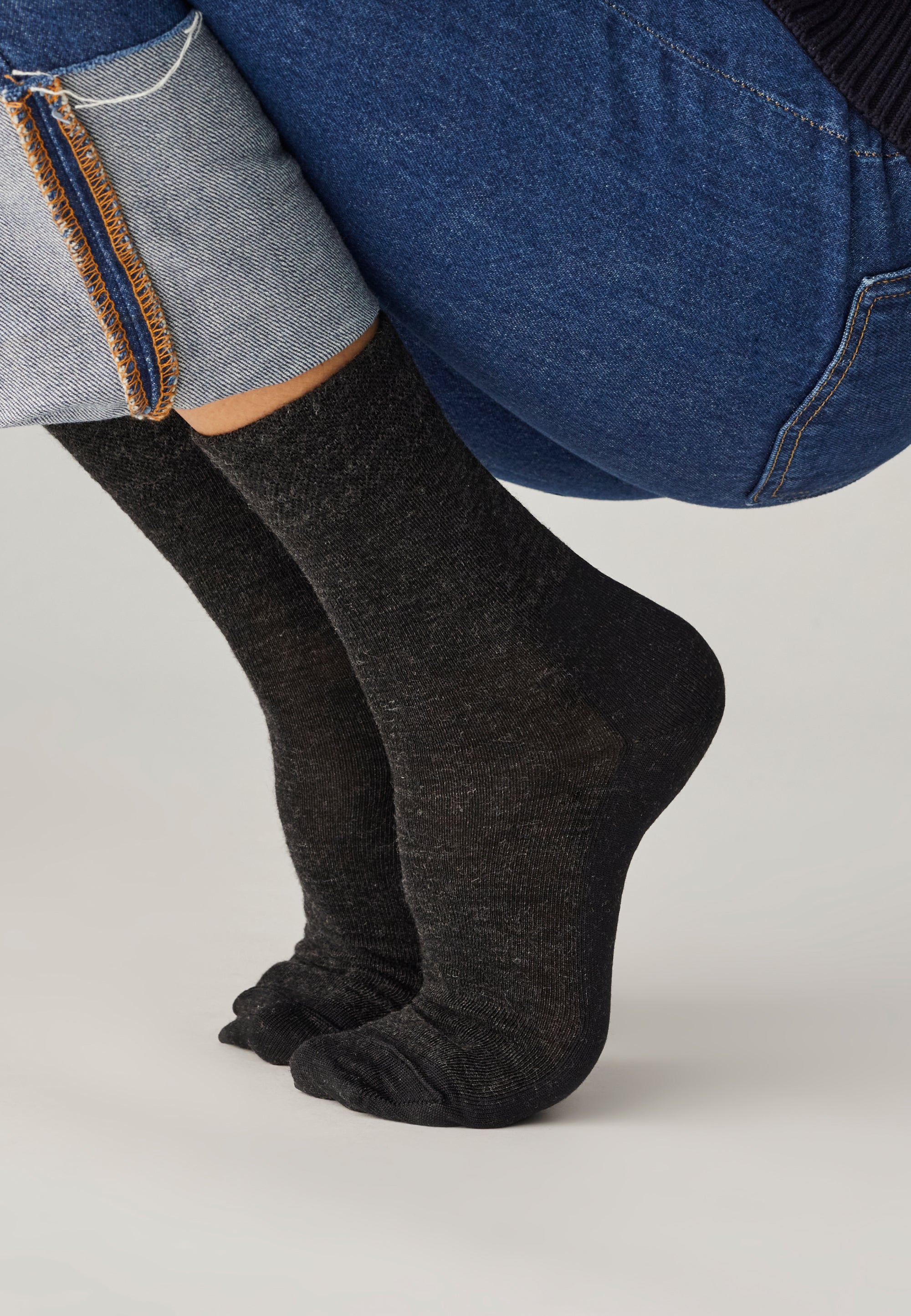


Wool Socks
Released in September 2021
These socks are made primarily of merino wool for softness and warmth, polyamide for durability, and a small amount of spandex for comfort.
According to our lab tests, thanks to the Cordura reinforcements, these socks are 15 times more durable than average. They can withstand 150,000 cycles, compared to 10,000 for a high-end sock brand. See the results
These socks were developed in collaboration with the French factory Atelier Joly (which also has its own brand, Missègle). They are produced at their factory near Castres.
Worn, tested, and approved by thousands of customers, these socks are the result of several years of continuous improvement. We have refined them over time to achieve a balance of quality, ethics, and price that we now consider optimal.
Techniques That Ensure Quality
 Total Easy Care Treatment
When exposed to water, friction, and heat, untreated wool shrinks and becomes denser (a process known as “felting”). At the microscopic level, this happens because the scales on the fibers interlock. To prevent this, a Total Easy Care treatment—also known as Superwash or KROY-ERCOSETT—is applied. The process involves oxidizing the scales on the fibers and then applying a very fine resin that forms a continuous film, which prevents the fibers from interlocking and thus prevents the wool from felting.
If this process is carried out in countries with low environmental standards, it can cause pollution. That is why we source our materials from the Suedwolle factory in Biella, Italy.
 Total Easy Care Treatment
 Cordura® Reinforcements
 Nylon Finishing
 Pre-wash
 Cordura® Reinforcements
These socks are reinforced at the heels and toes with Cordura®, a fiber that is four times more abrasion-resistant than standard nylon and is commonly used in military clothing.
Total Easy Care Treatment
Cordura® Reinforcements
Nylon Finishing
Pre-wash
 Nylon Finishing
A polyamide thread has been added to the soles of the feet and the Achilles tendon to delay the formation of holes. However, it’s only on the outside so that the skin remains in contact with the cotton: it’s softer and helps prevent sweating.
Total Easy Care Treatment
Cordura® Reinforcements
Nylon Finishing
Pre-wash
 Pre-wash
These socks are stabilized and pre-washed at the factory so they won't shrink when you wash them at home (with cotton garments, most of the shrinking occurs during the first wash).
Traitement Total Easy Care
Cordura® Reinforcements
Nylon Finishing
Pre-wash
Thin and warm
These socks are made of wool to keep you warm, but thin enough to wear with any of your shoes. Usually, the toe and heel are reinforced with standard polyamide. We, however, chose Cordura—a fiber originally used in the military that’s four times more resistant to abrasion. And to keep them in place without constricting your calf, the elastic is wide and has a “honeycomb” structure. They won’t let you down anytime soon—you can rest easy.
In detail
Honeycomb
The sock is held in place at the top by a honeycomb-patterned elastic band, a slightly honeycomb-like structure that provides good support without constricting the ankle too much.
Fine stitching
Seamlessly sewn "stitch by stitch" for added comfort
Size Guide
On the soles of the feet.
Composition
68% wool, 31% nylon, 1% spandex
Origin and Certifications
- Knitting: France (Tarn)
- Spinning mill: Italy
- Merino wool: Australia and South America
... not made from French sheep's wool? Because, unfortunately, it's not as fine as wool from the Southern Hemisphere, and because the French wool industry has almost completely disappeared. We explain all of this in more detail on this page.

How This Product Will Age
How do we know this? We ask our customers for their feedback on the product one year after purchase. And if the product is less than a year old, we provide our predictions based on some unsolicited feedback and our experience with similar products.
These socks will hold up very well over time and are much less likely to develop holes than regular socks. However, some people with particularly sharp toenails or who wear safety shoes have reported holes developing over time.
Pills may appear in areas of friction, particularly around the Achilles tendon... but nothing a lint shaver can't handle (tutorial here).
Care Instructions
It’s better to wash them at 30°C than at 40°C: it’s just as effective, much more eco-friendly, and it will extend their lifespan.
To make these socks last longer (and for the sake of the planet), it’s best to air-dry them. But sometimes you don’t have a choice: if you must use a dryer, set it to a low temperature (i.e., delicate or synthetic cycle) so that the spandex in the socks doesn’t lose its elasticity.
Due to friction from your shoes, pilling may occur, especially in areas like the Achilles tendon or the sole. In fact, this pilling is actually a good sign: the added layer of polyamide wears down to delay the appearance of a hole in the wool.
At first, the socks may feel slightly static and slip a bit in your shoes or on a well-waxed hardwood floor :) As you wash them, these effects will disappear and the socks will become softer.
And here are a few final tips for you to keep in mind. Don’t iron them to avoid stretching out the spandex. Wash them inside out to prevent hair or lint from other clothes from sticking to the outside of the sock. Trim your toenails. And wear shoes (they were invented for a reason).
Environmental Cost
This environmental cost is calculated using the official methodology of the French environmental labeling system (to be rolled out starting October 1, 2025).

The label above shows the product’s environmental cost according to the official French environmental labeling methodology. This represents what its production “costs” nature when considering its impact on climate change, ocean acidification, its toxicity to freshwater, and so on. Currently in use in the textile sector, this label should soon appear on many everyday consumer products (food, cosmetics, furniture, etc.) to help you make more eco-friendly purchasing decisions.
Wool socks therefore have an environmental cost of 179 impact points*.
By comparison, a garment of equivalent weight—made of 100% acrylic, manufactured in Bangladesh, and sold by a fast-fashion brand—has an environmental cost of 287 points*.
Why is there this difference? Here are the main reasons:
- Countries of origin: Manufacturing in Portugal or France requires less fossil fuel energy than in Bangladesh (one of the leading producers of low-cost clothing). As a result, this more local manufacturing reduces the impacts on climate change, ocean acidification, and resource depletion.
- The material: Wool has a fairly significant environmental impact, particularly because sheep release methane—a powerful greenhouse gas—during digestion. For this reason, the difference between the environmental impact of our product and that of fast fashion is not very significant. However, unlike acrylic, wool has major advantages: it is warm (thanks to its insulating properties), retains its shape (the fiber is very elastic), breathable (it wicks away sweat), and odor-resistant (it prevents the growth of bacteria).
- Sustainability: Fast-fashion retailers encourage purchasing—in particular by rapidly refreshing their collections and offering a vast number of styles—and they discourage repairs by charging rock-bottom prices. This, in turn, increases the number of garments sold per person and reduces the number of times a garment is worn. In contrast, at Loom, we’ve chosen to adopt business practices that encourage our customers to keep their clothes for as long as possible.
Even though we've done everything we can to minimize it, this product's environmental impact is not insignificant. So before you buy, make sure to get the most use out of your clothes.
*Calculations performed by Loom on August 24, 2026. Click on the links to access the simulations from the official Ecobalyse tool and get more details on the assumptions used. Please note: The number of points is not always exactly the same on Ecobalyse (whose methodology changes regularly) as on the official environmental label (based on Ecobalyse version 7.0).
Reviews of this product
The standard practice is to send review request emails a few days after the purchase. We wait a month—the minimum amount of time needed to form an informed opinion.
Customer Review Policy
When do you ask customers for reviews?
We’ll send you a review request one month after we receive your order. We believe this is the minimum amount of time needed to have worn and washed an item several times and to form a truly informed opinion. After that, all your reviews are published within a week, whether they’re positive or negative.
Do you request reviews for 100% of the products ordered by customers?
We used to do that at first, but then we realized we were starting to send way too many emails to certain customers who shop with us regularly. In short, we were spamming them a bit. Plus, it was starting to take the team way too much time to respond to reviews—since we want to reply individually and privately to almost everyone who leaves us a review. Today, we no longer ask for reviews on products that meet the following two criteria: 1/ There are enough reviews posted on the site for potential buyers to form an informed opinion about the product. 2/ We on the Loom team have read enough reviews to understand how to evolve the product into the next generation.
Just a quick thought: What proof is there that we aren't manipulating reviews by giving 5-star ratings to everything?
Honestly: nothing—we’re just giving you our word. Just like with everything else, actually: where we manufacture our products, where our wool comes from, our lab test results, and so on. The only times we might edit what you write is if your message contains spelling mistakes (and even then, quite a few slip past us) or if it’s racist, homophobic, etc. (but that’s never happened so far).
Asking for feedback after just one month isn't enough to know if the clothes are really durable, is it?
You're right—that's why we send you another email asking for a review one year after your purchase—we even ask for a photo to see how your garment has aged. We use the responses to improve our clothing and to provide information on “how this product will age” on our product pages. To avoid unnecessarily bothering our customers, we don’t ask for reviews on 100% of the products ordered: as soon as we have enough data to understand where we can improve, we stop asking for reviews after one year.