


The denim shirt
€75 for a shirt isn't cheap. But if you look closely, you'll see it has features you'll rarely find together:
- genuinely made in Europe: the shirt is made in Portugal and so is the fabric, whereas most brands have both produced in countries where wages aren't enough to live with dignity.
- use of organic cotton: it's the only way to avoid contributing to the mass extinction of biodiversity and to keep farmers out of harm's way. This commitment has a price: organic cotton costs 50% more than conventional.
- quality: on top of everything you can read on this page, all our clothes are pre-washed so they won't shrink on you, guaranteed free of any substance toxic to your health, and covered in case of a defect… And that standard comes at a cost too.
Honestly, you'll have a hard time finding a shirt to match this price. If we can sell it at this price, it's because we save on lots of things that feel unnecessary to us: we don't do advertising, no sales, no seasonal collections… and we don't have greedy shareholders demanding ever more profit.
Learn more.
Released in August 2021
We use organic cotton because so-called "conventional" cotton is a disaster for insects, birds and farmers. More info in this article.
235g/m2 is the equivalent of 7 oz, a slightly higher density than average. This fabric is both durable and comfortable.
Semi-fitted cut: it follows the line of your torso without clinging.
This shirt is made in Portugal, at the Supercorte factory we've been working with since 2017.
Worn, tested and approved by thousands of customers, this shirt is the result of a quality-ethics-price trade-off that we consider ideal as things stand today.
For example, we could bring the price down by dropping the organic cotton or the local manufacturing. But then again, what's the point of building an independent brand if you end up producing under the same conditions as fast fashion?
The techniques behind the quality
 Thick buttons
We went for thick resin buttons that won't break in the wash, unlike wooden or mother-of-pearl ones.
Just in case, a spare button is sewn onto the composition label.
 Thick buttons
 Ascolite® fixing
 Pre-washed
 Ascolite® fixing
To make sure the buttons don't come loose, we've reinforced how they're attached with Ascolite technology, a process that wraps the base of each button in a heat-fused thread.
Thick buttons
Ascolite® fixing
Pre-washed
 Pre-washed
This shirt is stabilised and pre-washed at the factory, so it won't shrink on you at home (with cotton clothes, most of the shrinkage happens during the first wash).
Thick buttons
Ascolite® fixing
Pre-washed
100% cotton, 100% cowboy


Cut from a beautiful Italian denim, this shirt will develop a lovely patina over the years (just like a pair of jeans). Sure, it looks good, but it's tough too: the fabric is dense (235 g/m²), the buttons are thick and their attachment is reinforced.
In detail

Candiani denim
An Italian manufacturer renowned for the quality of its denim fabrics.

Indigo dye
A so-called "pigment" dye that fades wash after wash, giving the fabric a distinctive shade.

Hidden button placket
Located under the collar points, to keep the collar in place (discreetly).

Chest pocket
To store your lasso.

Rounded cuffs
The sleeve ends are cut in a curve: they wear out less over time and washes.

Horizontal buttonhole
Only on the bottom button, to leave room for your belly.

Natural ecru
The ecru colour isn't achieved with dyes — it's the natural shade of (organic) cotton. By skipping the dyeing step, we not only get a fabric with real texture, but we also do without a whole lot of chemicals and greenhouse gases.


How to wear it
A few ideas if you're stuck


Composition
100% cotton
Origin and certifications
- Manufacturing: Portugal
- Weaving, dyeing and spinning: Italy
- Cotton: India
... manufacture in Portugal and not in France? Of course, producing in Portugal lets us sell at a lower price. But it's also easier to achieve good quality there: in the 1980s, when France offshored its industry, Portugal strengthened its own. That said, others do manage to make 100% made in France denim shirts, like Atelier Tuffery.
... not choose a denim fabric made in Portugal, to be close to where you make your clothes? We spent a long time looking for an organic denim fabric made in Portugal, without success...
... does the cotton come from so far away? Cotton always comes from far away. While a few die-hard Gauls manage to grow it in their fields, cotton farming is marginal in Europe. For this shirt, we can't influence where the cotton comes from geographically, because the yarns are selected by our weaver.

How this product will age
How do we know? We ask our customers what they think of the product one year after they've bought it. And if the product is less than a year old, we give you our predictions based on some spontaneous feedback and on our experience with similar products.
The denim shirt will stay in excellent condition. Like any denim shirt, it will fade with washing, particularly in areas of friction such as the elbows or the collar. If you don't like that but you're looking for a shirt with an uneven look, go for our cotton-linen shirt instead.
Care instructions
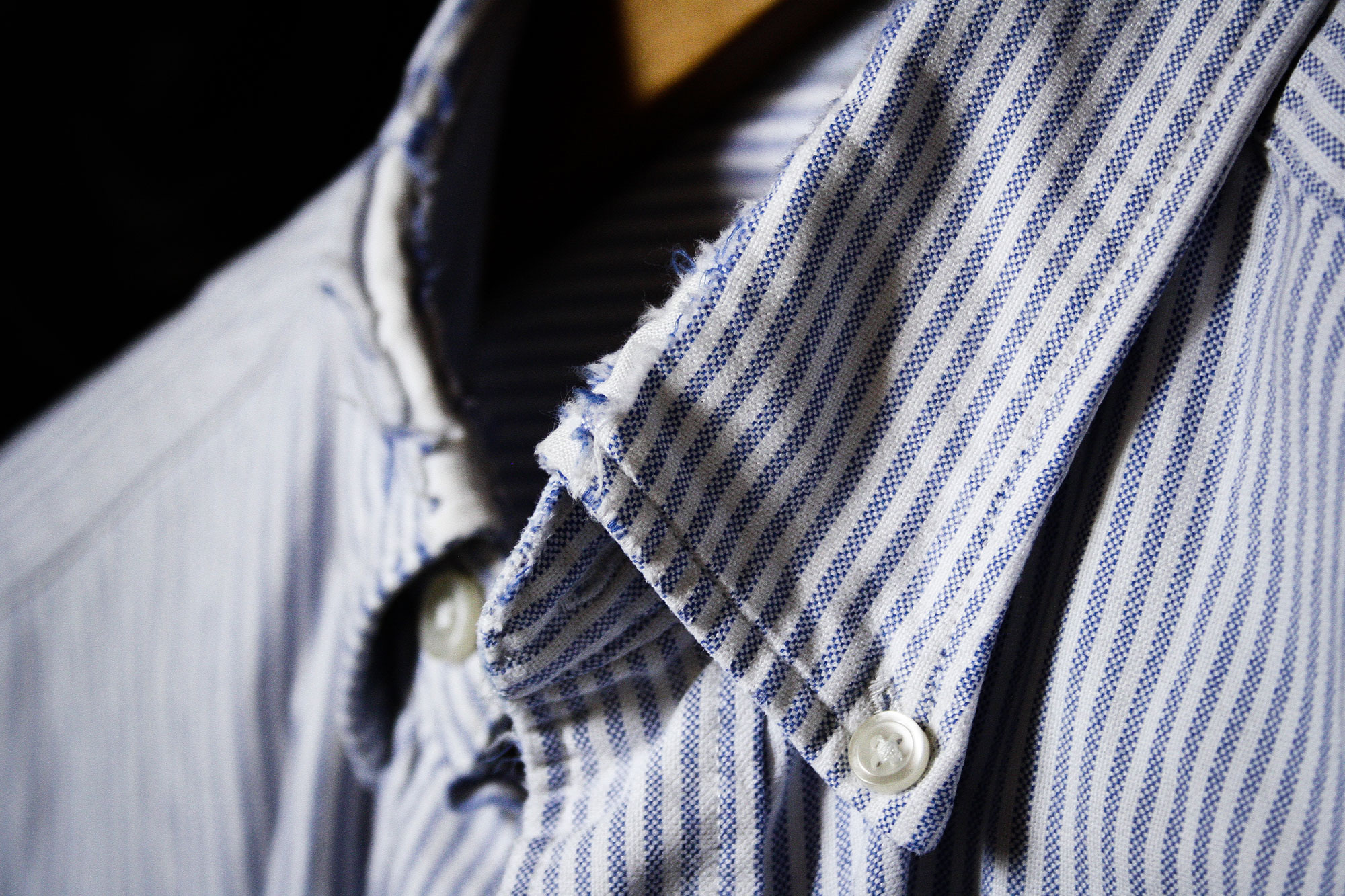
It's 100% cotton, so it can go in the machine at 40 degrees and can handle the tumble dryer. But it's better to wash it at 30°C and air-dry it: it's just as effective, far greener and it'll extend its lifespan. And be sure to unbutton the collar and cuffs to minimise friction and keep them from fraying over time (like here).
The rinse and bleached versions are indigo-based and will fade slightly with washing — that's completely normal. For the "rinse" version, it's wiser to wash it with similar colours to keep the indigo from bleeding onto your other clothes. If you plan to wear it over a white t-shirt, we recommend washing it once before putting it on to avoid any nasty surprises.
Our best tip for keeping your denim shirt from coming out too creased and making it easier to iron: spin at a low speed (600 rpm max) and hang it on a hanger while still damp. And ironing is an art we couldn't possibly teach you in a few lines: here's a good three-minute video demonstration. And remember to always iron your shirts inside out and at a low temperature to keep wear to a minimum.
Environmental cost
This environmental cost is calculated using the official methodology of the French environmental labelling scheme (in force since 1 October 2025).

The label above shows the product's environmental cost according to the official methodology of the French environmental labelling scheme. It's what its production "costs" nature when you look at its impact on climate change, ocean acidification, its toxicity to freshwater, and so on. Currently rolled out in the textile sector, this label should soon appear on many everyday consumer products (food, cosmetics, furniture, etc.) to help you shop in a more responsible way.
The denim shirt therefore has an environmental cost of 779 impact points*.
By comparison, a garment of equivalent weight, in 100% conventional cotton, made in Bangladesh and sold by a fast fashion brand, has an environmental cost of 3272 points*.
Why the difference? Here are the main reasons:
- The production countries: making clothes in Portugal or France requires less fossil fuel than in Bangladesh (one of the main producers of low-cost clothing). The result: this more local manufacturing limits the impact on climate change, ocean acidification and resource depletion.
- The material: organic cotton has a fairly low environmental impact compared with conventional cotton, mainly because it uses few pesticides (so low toxicity for freshwater) and is biodegradable (so fewer issues with microfibres or end-of-life waste).
- Durability: fast fashion brands drive purchases in particular by refreshing their collections very quickly and offering a huge number of styles, and they discourage repairs by charging laughably low prices. This increases the number of garments sold per person and reduces the number of times a garment is worn. At Loom, we've taken the opposite route: we've chosen business practices that encourage our customers to keep their clothes as long as possible.
Even though we've done everything we can to keep it as low as possible, this product's environmental impact isn't negligible. So before you buy, make your clothes last as long as possible.
*Calculations performed by Loom on 14/09/2026. Click the links to access the simulations from the official Ecobalyse tool and get more details on the assumptions used. Please note: the number of points isn't always exactly the same on Ecobalyse (whose method evolves regularly) as on the official environmental labelling (based on version 7.0 of Ecobalyse)
Reviews for this product
The standard practice is to send review request e-mails a few days after the purchase. We wait a month, the minimum time needed to form a well-informed opinion
Customer review policy
When do you ask customers for reviews?
We send you a review request one month after you receive your order. We reckon that's the minimum amount of time needed to have worn and washed a garment several times and to really form a well-informed opinion. After that, all your reviews are published within the week, whether they're good or not.
Do you ask for reviews on 100% of the products customers order?
We used to do that at first, then we realised we were starting to send far too many emails to some people who buy from us regularly. In short, we were spamming a bit. On top of that, it was starting to take up way too much of the team's time to reply to reviews - since we want to reply individually and privately to almost every person who leaves us a review. Today, we no longer ask for reviews on products that meet the following two criteria: 1/ There are enough reviews shown on the site for people who want to buy to form a well-informed opinion about the product 2/ We've read enough reviews within the Loom team to understand how to improve the product for the next generation.
Hold your horses: what proves we don't tamper with reviews by slapping 5 stars everywhere?
Honestly: nothing, we're just giving you our word. Same as for everything else, by the way: where we manufacture, where our wool comes from, our lab test scores, and so on. The only times we might touch what you write are if your message contains spelling mistakes (and even then, quite a few slip past us) or if it's racist, homophobic, and so on (but that's never happened so far).
Asking for a review after a month isn't enough to know whether the clothes really are durable, is it?
You're right, which is why we send you another review request email a year after your purchase – we even ask for a photo to see how your garment has aged. The answers help us improve our clothes and provide information about "how this product will age" on our product pages. To avoid bothering our customers needlessly, we don't ask for these reviews on 100% of the products ordered: as soon as we have enough data to understand the areas for improvement, we stop asking for the one-year reviews.